
What Is a Vertical Pivot Lift Gate? How It Works and Why It’s Different
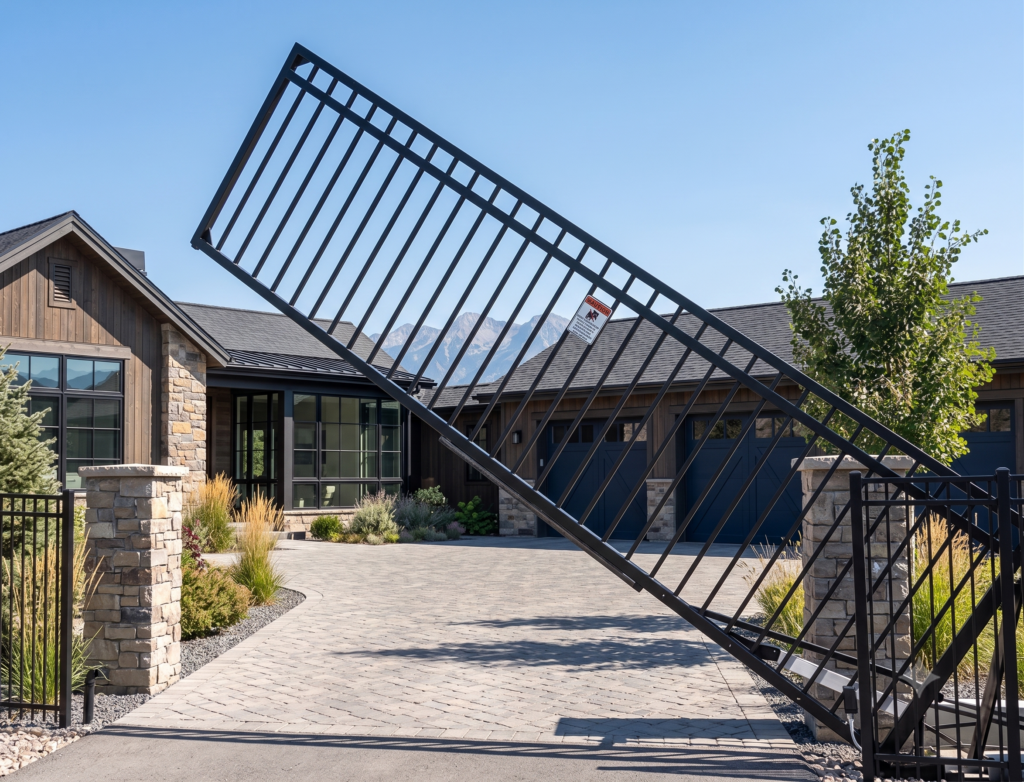
If you’ve been shopping for a driveway gate, you’ve probably run across the term “vertical pivot lift gate” and wondered how it’s different from a swing gate, a slide gate, or a true vertical lift gate. It’s a fair question — the name alone packs in two ideas, pivoting and lifting, and not every manufacturer uses it the same way.
Here’s the short version: a vertical pivot lift gate is a single solid panel that pivots up and out of the way to open, instead of swinging to the side or rolling along a track. It’s a design Lazy Gate has been building and refining in the USA since 1973, and it quietly solves several problems that trip up other gate styles. Below, we’ll break down exactly how it works, clear up the pivot-versus-lift confusion, and explain why so many homeowners, farms, and businesses choose it.
What Is a Vertical Pivot Lift Gate?
A vertical pivot lift gate is an automated entry gate built around one rigid panel and a single pivot point set to one side of the opening. When the gate is closed, the panel stands upright across your driveway like any other gate. When you open it, the panel rotates upward — lifting up and back until it sits clear of the drive, angled overhead and out of your way.
That motion is the whole point. Because the panel rises into the air rather than sweeping sideways or rolling down a track, the gate needs very little room to operate. There’s no wide arc of clearance to keep empty for a swinging leaf, and no long stretch of fence line for the panel to slide into.
Vertical Pivot vs. Vertical Lift: Clearing Up the Terminology
The phrase “vertical pivot lift gate” gets used loosely, so it helps to separate the two mechanisms people are usually picturing.
A vertical pivot gate rotates on an axis near the base, swinging the panel upward at an angle — similar to a barrier arm, but with a full, solid gate panel instead of a thin bar. A true vertical lift gate, by contrast, rises straight up along a vertical track or a pair of towers, more like a guillotine.
When people say “vertical pivot lift gate,” they’re almost always describing the pivot style: a gate that lifts the panel up and clear by pivoting it. You get the same up-and-out-of-the-way result as a straight vertical lift, but without the tall overhead towers and tracks that a guillotine-style system requires. That’s the design Lazy Gate manufactures.
How a Vertical Pivot Lift Gate Works
The mechanics are simpler than they look. The gate panel is anchored at one side over a compact foundation, and a counterbalanced operator does the heavy lifting — literally. Because the load is balanced, the motor manages the panel smoothly instead of hoisting its full dead weight. Trigger the gate and the operator pivots the panel up and back; close it and the panel rotates back down into position across the opening.
Lazy Gate’s newer systems are powered by LiftMaster operators paired with a patented lift design that keeps the foundation footprint small. The result is smooth, predictable operation with intuitive controls, plus the option to add keypads, a cloud app for phone control, and solar power for off-grid or remote entrances. And because the moving parts live in the operator rather than on the ground, there’s no track to jam and no rollers grinding through dirt and debris.
Why a Vertical Pivot Lift Gate Is Different
This is where the design really separates itself from swing and slide gates. A few standouts:
- The smallest footprint in the industry. Lazy Gate’s system is engineered around minimal foundation requirements, which gives you far more flexibility in where the gate can go. Tight entrances, short driveways, and spots boxed in by landscaping or structures — places where a swing gate has nowhere to open and a slide gate has nowhere to run — are usually no problem for a pivot lift.
- It shrugs off snow. Since the panel lifts up rather than sliding or sweeping across the ground, it isn’t fighting a snowbank every time it opens. That’s a big reason vertical pivot gates are so popular in cold, high-snowfall regions where slide and swing gates stall out. Lazy Gate builds its gates specifically to hold up to harsh weather and heavy use.
- Strong security. A vertical pivot lift gate is a single, solid panel that’s difficult to force or breach — a confident choice for homes, gated communities, and commercial properties that take perimeter security seriously.
- Low maintenance, built to last. Every Lazy Gate panel gets a two-coat powder-coating process that resists chipping, scratching, and corrosion far better than ordinary paint, so the finish stays sharp for years. With no ground-level track or roller assembly to service, there’s simply less to go wrong.
- Easy to install. The small foundation and straightforward system have made Lazy Gate a favorite in the DIY community — plenty of owners install their own gates — while still being ready for professional installation when you’d rather hand it off.
Where Vertical Pivot Lift Gates Work Best
The mix of a small footprint, weather resistance, and solid security makes this gate style genuinely versatile. Common fits include:
- Residential driveways that need privacy and curb appeal without giving up yard space.
- Farms and ranches, where heavy 5-rail gates and long, rugged entrances are the norm.
- Gated communities that want a clean, consistent look across many entrances.
- Commercial and industrial sites that need dependable, secure access in tight quarters.
- Remote properties and cabins, where solar power keeps the gate running off-grid.
Lazy Gate ships nationwide and has gates installed in all 50 states, so location and climate are rarely a barrier.
What Makes Lazy Gate’s Vertical Pivot Gates Stand Out
Lazy Gate has been manufacturing vertical pivot gates in the United States since 1973 — handmade, custom-built, and shipped across the country. Standard gates run from 8 to 24 feet wide and up to 6 feet tall, with style options ranging from sleek double-rail decorative panels and chain link to heavy 5-rail farm gates, in either steel or aluminum. Complete vertical gate packages start at $13,995, and a full lineup of accessories — keypads, the MAX cloud app, solar panels, even custom barbed wire — lets you tailor the system to your property.
Is a Vertical Pivot Lift Gate Right for You?
If you want a driveway gate that opens reliably in tight spaces, stands up to snow and weather, and delivers serious security with minimal upkeep, a vertical pivot lift gate is hard to beat. The design earns its keep day after day — quietly, and without the headaches that come with tracks and rollers.
Ready to see what fits your entrance? Request a quote from Lazy Gate, explore the residential vertical gate, or browse the full gate lineup to find the style that’s right for your property.